


Hosepipe bans FAQs
+ -
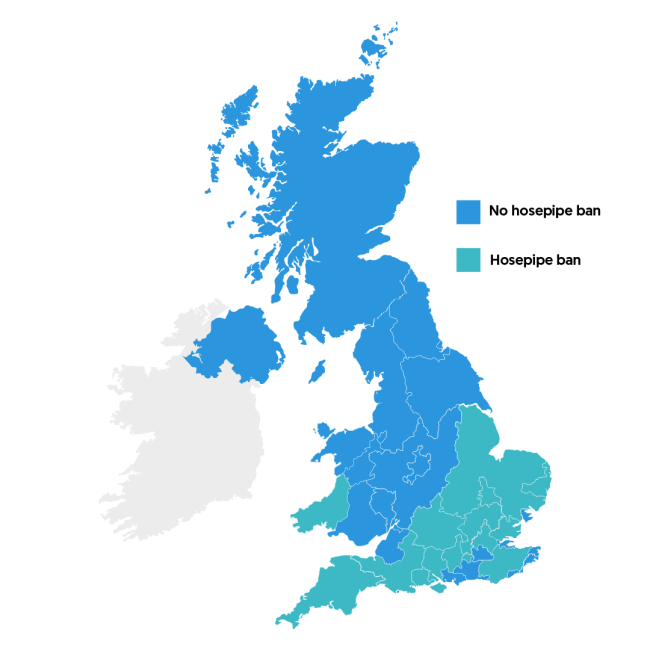
- Affinity Water, Anglian Water, Cambridge Water, Essex and Suffolk Water, Southern Water, South East Water, South West Water, Thames Water and Wessex Water have announced they are implementing Temporary Use Bans (hosepipe ban) – for some or all of their customers.
- Other European countries such as France, Portugal, Spain and Ireland have also implemented restrictions.
- According to the Met Office England and Wales have had the driest July on record, with drought declared in two thirds of England.
- The hot weather has led to an unprecedented demand for water with some companies seeing demand rise by up to a third.
- A fifth of rivers are now exceptionally low because of the hot, dry summer. The River Test in Hampshire, for example, has lost a third of its water recently.
+ -
- Affinity Water has implemented restrictions in its Central region, covering Bedfordshire, Berkshire, Buckinghamshire, Hertfordshire, Surrey, and parts of London and Essex. The restrictions came into force on July 10th 2026. More information can be found on the Affinity Water website here.
- Anglian Water has implemented restrictions across its whole region. The restrictions came into force on July 11th 2026. More information can be found on the Anglian Water website here.
- Cambridge Water has implemented restrictions across its whole region. The restrictions came into force on July 17th 2026. More information can be found on the Cambridge Water website here.
- Essex and Suffolk Water has implemented restrictions for all household customers across their supply area. The ban came into force on August 3rd 2026. More information can be found on the Essex and Suffolk Water website here.
- Southern Water has implemented restrictions for their customers in Hampshire and the Isle of Wight. This came into force on July 10th 2026. More information can be found on the Southern Water website here.
- South East Water has implemented restrictions for their customers in Kent. This came into force on July 3rd 2026. They also introduced restrictions in Sussex, Surrey, Hampshire and Berkshire from July 25th 2026. More information can be found on the South East Water website here.
- South West Water has implemented restrictions for their customers in Mid Devon and parts of East Devon. The ban came into force on July 14th 2026. They also introduced restrictions for all customers across Devon, Cornwall, parts of Dorset and Somerset and the Isles of Scilly. This came into force from August 8th 2026. More information can be found on the South West Water website here.
- Thames Water has implemented restrictions for all customers whose water is supplied by Thames Water (covering most of Greater London, Luton, the Thames Valley, Surrey, Gloucestershire, north Wiltshire and far west Kent). The ban came into force on July 23rd 2026. More information can be found on the Thames Water website here.
- Wessex Water has implemented restrictions for all their customers. The ban came into force on August 18th 2026. More information can be found on the Wessex Water website here.
+ -
- Water companies are doing everything they can to prevent further restrictions. They are deploying leakage surge teams and moving water across their regions to relieve the driest areas.
- Water companies monitor regional conditions daily and follow clear trigger points such as groundwater and reservoir levels, river flow rates, and long-range weather forecasts.
- Conditions vary by region, so not all areas will face the same restrictions at the same time.
+ -
- The actions companies are taking now are designed to protect the environment and preserve water supplies so that customers have the water they need when they need it.
- The hot weather means river levels are lower than expected for this time of year. The River Test in Hampshire, for example, has lost a third of its water within the last month.
- By introducing hosepipe restrictions, companies are hoping to reduce water usage which will help to conserve the water in reservoirs and help them to top back up when we do have some rain. Reducing usage now will also help water companies to ensure treatment works can keep pace with increased demand.
+ -
- Water companies understand the inconvenience to customers of introducing restrictions on water usage. No company wants to introduce restrictions if they can possibly be avoided.
- Each company has its own plan – which has been agreed with Ministers and regulators and consulted on publicly. This plan sets out when Temporary Use Bans could become necessary in a given area. Restrictions are part of our planned and pre-agreed system for managing severe weather conditions.
+ -
- Hot, dry weather leads to more water use for gardens, washing, paddling pools, and cooling.
- Some companies have seen demand increase by up to a third during the recent extremely hot weather
+ -
In areas under a Temporary Use Ban, you cannot use a hosepipe or similar device for activities like:
- Watering gardens or plants.
- Filling paddling pools or hot tubs.
- Cleaning cars, buildings, patios, or decking.
- Buckets and watering cans are generally allowed, and some exemptions may apply (e.g., for health and safety or vulnerable customers).
Check with your local water company for specific rules.
+ -
- The length of a Temporary Use Ban will vary from company to company. Generally speaking, restrictions will remain in place until water resources improve and environmental pressures ease.
- Companies assess the situation continuously, taking into account weather forecasts, reservoir levels, and ecological health.
- Customers will be kept informed as restrictions change or lift.
+ -
- In the short-term, companies are deploying leakage surge teams and moving water across their regions to relieve the driest areas.
- Companies are also ramping up production of water to meet demand and taking water from different sources to help relieve pressure on hot-spots – including to help other sectors like agriculture.
Between now and 2030 water companies are investing £5 billion to expand water supplies. This includes:
- The development of ten new reservoirs, the first of which is already under construction at Havant Thicket in Hampshire.
- New water transfer schemes, such as using the Grand Union Canal between Birmingham and London, and new water treatment infrastructure.
- Rolling out 10 million smart meters over this period.
- Tripling the rate of water mains replacement to secure the network against leaks.
- Together, this action will produce hundreds of millions of litres of extra water supply by 2030.
+ -
- Everyone can play their part by carefully considering the amount of water they use.
- Our national water saving campaign – Water’s Worth Saving – has helpful hints and tips on how to reduce water use in the home and garden.
+ -
- Different exemptions may exist in your region. Check with your water company to see the rules that apply.
- If a customer has certain disabilities or health issues that make it difficult to use alternatives to a hosepipe (e.g. lifting watering cans), they may be exempt.
- Companies also offer further support through the Priority Services Register for a wide range of people, from those with sight, hearing, or mobility difficulties, to parents with babies under 12 months old.
+ -
- Leakage is at the lowest level ever recorded, down around 40% since the 1990s.
- Water companies will invest record amounts over the next five years repairing leaks and upgrading infrastructure, to improve leakage even further.
- During the current hot conditions, it is possible for dried, cracking soil to move and press on pipes, increasing the likelihood of new bursts. Companies currently have hundreds of people out each day finding and fixing these as they occur to make sure we continue making progress.
- Teams are increasingly using advanced technology like intelligent networks and smart sensors, artificial intelligence, and satellite and drone technology to detect leaks, and new advanced techniques to repair them quickly – sometimes without even needing to dig up the road.
+ -
- Several schemes were delayed in the past due to regulatory and planning vetoes.
- However, over the next five years water companies will start work on nine new reservoirs as part of their record £104 billion investment to secure our water supplies, help build more homes and support economic growth.
- In addition, a tenth reservoir (Havant Thicket) is already under construction outside Portsmouth.
+ -
Most people understand the need to conserve water, but if you see someone ignoring a ban:
- Consider politely reminding them of the restrictions and the reasons behind them.
- If needed, you can report breaches to your local water company.
- Companies prefer to offer advice and support first, but fines can be issued if necessary.
Frequently Asked Questions
Saving water at home
Saving water at home saves time, money and helps the environment. It's easy to start with our expert tips.